
Today marks thirty years since my mother died.
Anniversaries have a strange way of rearranging memory. Some things blur with time. Others grow sharper, almost architectural. Rooms return. Objects return. Small scenes return with an almost stubborn clarity.
For me, one room always comes back first.
My mother’s formal living room. It was meditative in a way that the rest of the house was not. The light seemed dimmer. Conversations softened when guests stepped into it. Even the furniture carried a certain gravity, as if everything in the room had been asked to behave itself.
She redesigned it in 1966, and she approached the project with the seriousness of someone building a small private world. She saved money for years to hire a decorator from New York City. Every detail mattered to her.
The furniture was French Provincial, upholstered in a silky, off-white fabric, decorated with embroidered olive-green motifs depicting 17th-century French court life. The chairs and sofas shared the same curvaceous shape. In the center of the room sat a large, round marble coffee table that was perpetually cold to the touch and so far from the seating that no one could comfortably reach it. It was not a table for coffee cups. It was a table that simply existed at the center of the room, like a small white planet.
What mattered most to her, though, were the shelves.
She wanted built-in bookcases constructed along one wall, but she designed them in a very particular way. The trim was painted off-white. The fronts of the shelves were off-white as well. Only the back panels were olive green. The result was a kind of three-dimensional rectangle of green compartments, each shelf framed by pale borders.
As a child, I thought the finished wall looked like a dollhouse turned inside out: a series of little rooms stacked in quiescent rows, muted by the olive tone, and deep enough to make the spaces feel claimed and intimate by the cluster of figurines she placed in them.
Most of the figurines were miniature replicas of Greek and Roman gods and goddesses — Athena, Hercules, and the Three Furies. Others were religious icons: St. Barbara, St. Martin de Porres, and St. Francis. Still others depicted small scenes from a different world entirely: French maidens strolling with their suitors, elegant women walking poodles, porcelain couples frozen mid-courtship in some silent eighteenth-century garden. And then there were the pieces that felt like outliers — none more so than the dark, arresting Sicilian ceramic heads known as Teste di Moro, each one holding an entire Mediterranean tragedy in its glaze.
For decades, the room baffled me — one more of my mother’s eccentricities, I assumed, and left it at that. The Olive Room clearly contained bookcases. What it didn’t contain, at least visibly, were any books.
Beneath the front windowsills ran a row of cabinets with doors. Inside them were the volumes that actually constituted the house’s central library: a full 24-volume set of the 1951 edition of Encyclopaedia Britannica, several atlases of the world, and other reference books on philosophy, history, mathematics, and science. She chose to tuck away the serious books, while the shelves around displayed tranquil crowds of gods, saints, lovers, conquerors, settlers, and animals — each an unexpected conversation piece.
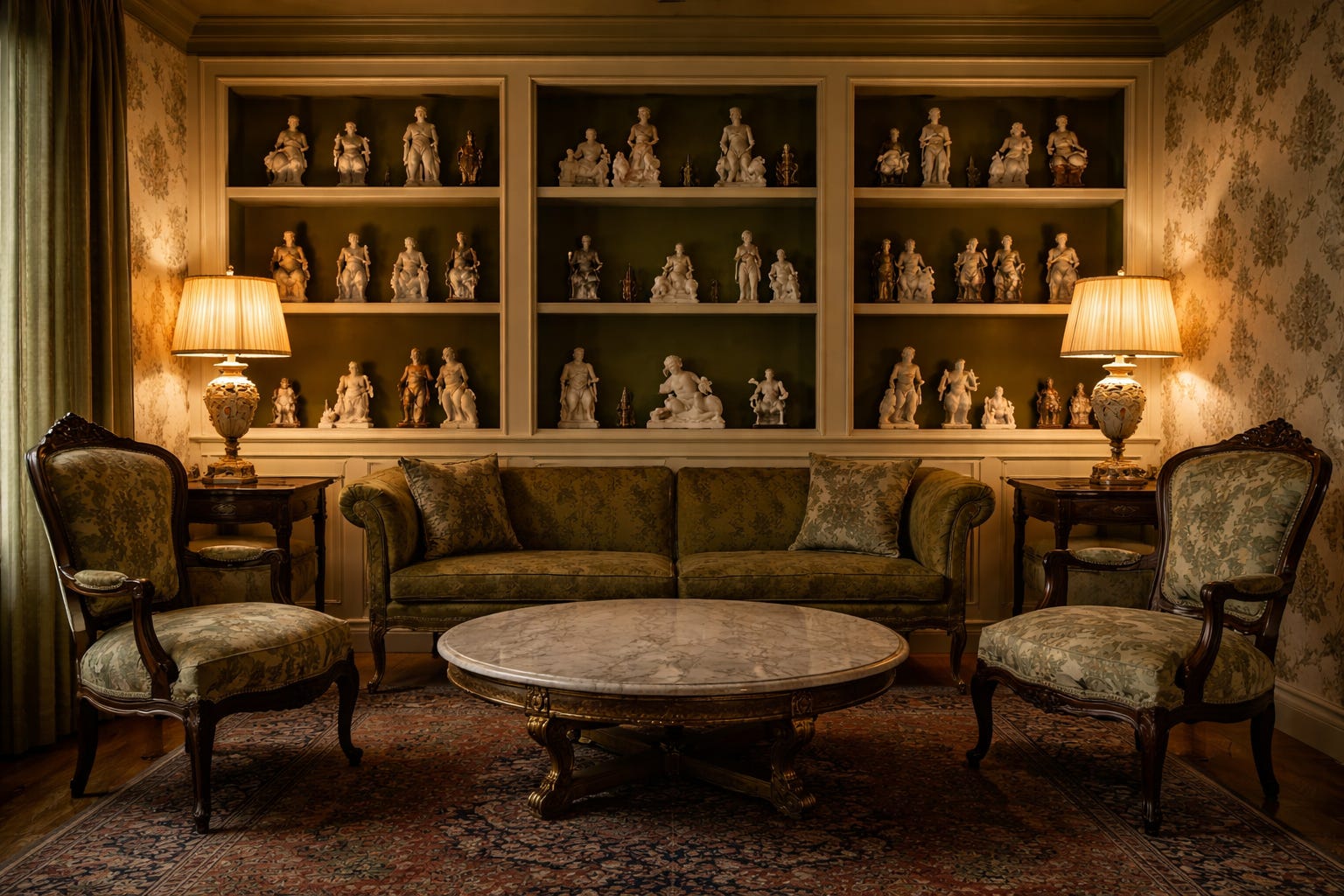
Although the Olive Room was technically the formal living room for guests, it always felt more like my mother’s private sanctuary.
Out of respect for that feeling, I rarely touched anything inside it.
I did not yet understand what the room meant to her. Now I think she had built a kind of philosophical diorama.
Those figurines were not decoration to her. They were stories made visible — moral exemplars, tragedies, acts of courage, devotion, betrayal, sacrifice. Greek virtue and Catholic sainthood lived side by side on the same wall without conflict. These were the more important “books” to present to her guests.
Each figurine served as a quiet symbol of human virtue, with a narrative about what a life might look like if deliberately shaped.
The encyclopedias below the window — the repositories of knowledge — remained present but unseen, like foundations beneath a house.
Knowledge mattered.
But character mattered more.
My mother never used philosophical language; instead, she constructed her own version of virtue ethics. Long before I encountered Aristotle, Aquinas, Bentham, or modern debates about utilitarianism in a university setting, she had already chosen the framework she trusted. She believed that the moral life was not primarily about calculating outcomes. It was about becoming an admirable, respectable person and treating other people with unconditional dignity.
She had a small set of principles she returned to again and again, often in response to the statecraft she read in the news or to a tragic outcome stemming from the hamartia of a friend or acquaintance. She believed you should always consult people who have lived through what you are attempting — their scars are data. She believed in being respectful, unconditionally and without exception. And she believed that no one can predict outcomes, because the world contains too many variables.
It was a Sunday morning, not long after the assassination of Yitzhak Rabin. She was listening to a talk show — two men arguing about how Israel should respond to terrorism. One said all the marketplaces should be shut down to save lives. The other, the extremist, said the marketplaces should stay open, but the army should be allowed to shoot suspected terrorists on sight.
At the height of it, she turned to me and said, calmly: “I am sure Israelis pass off-duty terrorists in the markets every day. Should the state blow up every market to ensure there will never be a terrorist in a market again?”
That was her method — a single absurdist sentence, softly delivered, and the moral panic deflated.
What she was puncturing, without naming it, was utilitarian reasoning: the idea that actions should be measured by their consequences, that the right decision is whichever one produces the greatest good for the greatest number. In theory, it sounds humane. In practice, it becomes the language of statecraft — the justification for wars, sanctions, and policies that knowingly harm some people in the belief that greater benefits will follow later. She distrusted that logic instinctively, because she understood where it leads: once you allow people to become variables in a calculation, the calculation can justify almost anything.
She hadn’t studied philosophy. She distrusted it because she had lived long enough to see how quickly human beings begin to sound reasonable while justifying the unreasonable. She had watched the twentieth century unfold in newspapers and radio broadcasts and evening television: wars explained, cities bombed, policies debated in language that always promised a greater good just over the horizon.
Her resistance was more taciturn than that.
She did not argue systems. She returned, again and again, to the person in front of her. To dignity. To restraint. To the small disciplines that prevent a society from sliding into cruelty while claiming it is doing something noble.
My mother practiced virtue ethics without ever needing the vocabulary.
Looking back now, the Olive Room feels less like decoration and more like a modest thesis about how a life should be arranged.
The saints and gods stood there not only as examples but as witnesses. Each one represented some fragment of the long human effort to understand what makes a life admirable: courage, loyalty, humility, wisdom, beauty, devotion. They came from different civilizations and different centuries, yet my mother placed them side by side as if they belonged to the same moral conversation.
Perhaps they did.
The encyclopedias below the window contained the measurable facts of the world — the distances between continents, the chemical properties of elements, the dates of revolutions and treaties. That knowledge mattered, and she kept it carefully. But she understood something that universities sometimes forget: knowledge tells us how the world works; character determines how we move through it.
It took me fifty years to understand why the Olive Room felt visually overwhelming and slightly sacred, and why I instinctively left its shelves untouched. I sensed, even as a child, that I was stepping into a place where something important was being preserved.
Not wealth.
Not status.
But a moral inheritance.
The Olive Room was my mother’s reserved argument with the modern world — a world increasingly convinced that everything can be reduced to calculations of outcome and efficiency. She answered that conviction not with manifestos but with arrangement: a wall of figures reminding anyone who entered that human beings have always struggled with the question of how to live well. The room itself is gone now. Houses change hands, walls are repainted, figurines are dispersed into the long afterlife of objects. But I still picture those shelves: the olive interiors framed in pale wood, each square a small apartment for some fragment of the human story — Athena beside St. Francis, lovers in porcelain gardens, the Teste di Moro watching over everything with that mysterious, tragic gaze. A wall of lives lived symbolically, each one asking the same enduring question: what kind of person will you become?
It was never really about the figurines. It was about that question — and about the hope that the answer might be shaped, slowly and deliberately, one small act of character at a time.
My mother built her philosophy out of olive paint, porcelain figures, and the stubborn conviction that character matters more than calculation. If rooms can hold the memory of the people who loved them, that olive one is glowing tonight.


