Power Does Not Argue

I was a teenager when I first encountered Commentary magazine, not in a university library, but on a newsstand. Until then, I had assumed that serious thinking about politics, power, and morality belonged to experts behind institutional walls. What startled me was not just the intelligence of the essays, but their posture: arguments unfolded slowly, insistently, without slogans. Moral claims were made, defended, and contested. Conclusive judgment was not treated as a liability. It was the point.
That discovery changed how I understood what my instructors had been trying to teach me all along. Critical thinking was not an abstract skill; it was something you could watch happening on the page. Ideas argued with one another. History was invoked not to settle the debate, but to deepen it. In this context, I understood that authority isn’t allowed a free pass from debate, because it is authority.
That posture feels increasingly unfamiliar in today’s America.
In recent weeks, Minneapolis became the site of large-scale federal immigration enforcement following the deaths of two residents during encounters with enforcement officers. Citizen outrage prompted not reconsideration but escalation: additional federal agents, warnings of "zero tolerance," and sharply narrowed definitions of acceptable protest. Officials invoked urgency, necessity, and procedure. When residents raised constitutional concerns about limits, proportionality, and accountability, these were acknowledged but deferred. Investigations would come. Congress bore responsibility. In the meantime, enforcement continued as though its moral standing were already settled.
What struck me was not simply the policy choice, but the manner of its defense. Moral justification did not disappear; it was replaced. Claims were categorical rather than argumentative. Authority spoke as though explanation itself were optional.
There is an image that captures this moment with unsettling clarity—not as metaphor, but as memory.
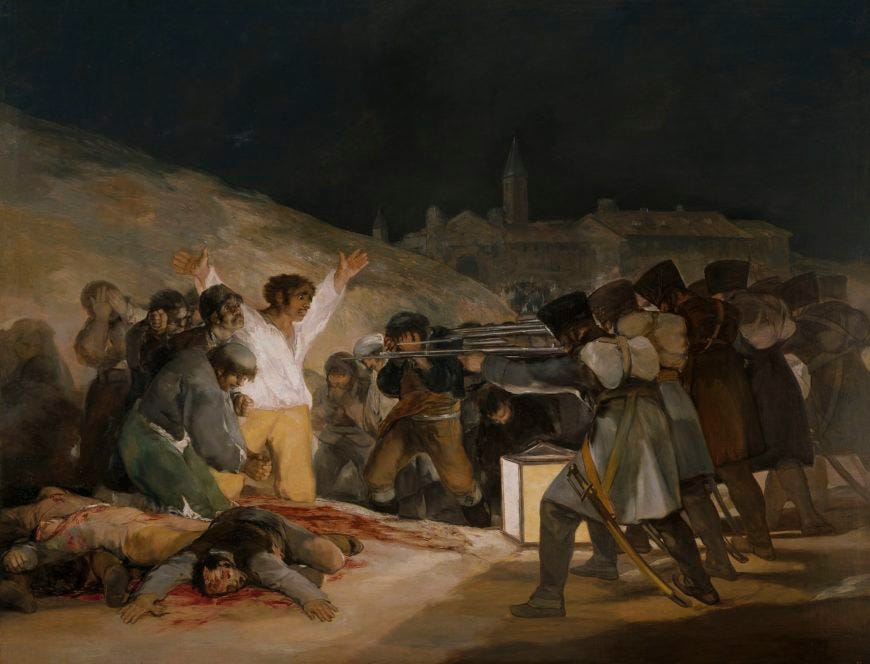
Francisco Goya’s The Third of May 1808 depicts the execution of Spanish civilians by Napoleon’s occupying forces after an uprising in Madrid. Painted in 1814, the work rejects the conventions of heroic battle painting. The soldiers’ faces are hidden; they are mechanism, not character. The victims, lit harshly by a lantern, are unmistakably human—terrified, pleading, already dead. No justification is offered. No necessity is explained. The painting refuses to argue on power’s behalf.
What gives the image its lasting force is not its brutality, but its clarity. Authority does not persuade here. It does not deliberate. It fires. Judgment is left entirely to the viewer, who is denied the comfort of abstraction. Goya does not ask whether the executions were legal or effective. He asks whether we can bear to look at what power does when it no longer feels the need to explain itself.
The image is harsh because the reality it names is harsh. It belongs here not as an analogy, but as a reminder: when explanation disappears, violence does not always arrive with spectacle. Sometimes it arrives with efficiency, uniforms, and the quiet confidence that no argument is required.
We have seen this before
The posture on display in Minneapolis—the appeal to necessity, the deferral of judgment, the narrowing of moral standing—has appeared repeatedly in American history. Not always in moments we like to remember. Often in moments we later prefer to describe as exceptions.
During World War II, more than 600,000 Italian Americans were classified as “enemy aliens” under Proclamation 2527. Thousands were subjected to curfews, travel restrictions, property seizures, and internment. These measures were administered quietly, through permits and categories, justified as temporary safeguards of national security. They were legal. They were orderly. Accountability was dispersed across agencies and timelines. Moral reckoning was postponed until after the emergency had passed—at which point it felt abstract, even impolite, to reopen the question.
A similar logic governed the internment of Japanese Americans, where military necessity was invoked to justify mass detention without individualized suspicion. The Supreme Court upheld the policy at the time. The machinery of law functioned. Only decades later did the nation acknowledge that legality had stood in for judgment, and that urgency had silenced moral scrutiny.
The pattern extends beyond wartime internment. During the Red Scares of the twentieth century, loyalty programs, blacklists, and surveillance regimes were framed as protective rather than punitive. Careers were destroyed through administrative processes rather than criminal trials. The accused were rarely told they were immoral; they were told they were risks. Once again, judgment was displaced by classification, and responsibility dissolved into procedure.
Even earlier, slavery itself was sustained through this same architecture. It endured not because Americans lacked moral language, but because moral accounting was repeatedly deferred to law, custom, and economic necessity. Court decisions, constitutional compromises, and statutory frameworks treated human beings as property while preserving the appearance of legitimacy. Objections were not refuted so much as absorbed—answered with precedent, stability, and the claim that no alternative was workable now.
What unites these episodes is not cruelty as such, but a recurring moral move: when power feels pressed, it stops arguing. It invokes urgency. It narrows who counts as a full moral subject. It treats judgment as irresponsible until conditions improve—conditions that its own actions help sustain.
Minneapolis belongs to this lineage not by equivalence, but by structure. Enforcement is framed as inevitable. Protest is tolerated only insofar as it does not interfere. Responsibility is deferred to investigations yet to conclude. Law is invoked not as a site of moral reasoning, but as its endpoint.
History rarely repeats itself verbatim. It reasserts its logic. And that logic is most dangerous when it presents itself as reasonable, temporary, and regrettably necessary. When authority replaces argument
This posture marks a deeper shift: power no longer presents itself as something that must persuade. It presents itself as something that must be managed.
Here, the contrast with an older mode of public reasoning becomes stark. In a 1977 essay for Commentary, Walter Laqueur insisted that human rights could not be treated as aspirational ideals to be honored later. “It is… the theory of absolute nonintervention to protect human rights that is nonsense upon stilts,” he wrote, arguing that legality and sovereignty could never serve as moral closure (Laqueur, 1977/2015). Moral claims, for Laqueur, demanded confrontation, not deferral.
Compare that posture to a much later Commentary essay celebrating what Noah Rothman called a “proper contempt” for international institutions that ask states to justify themselves morally. Rothman praised the rejection of “diplomatic process as its own end,” describing the United Nations as a venue unworthy of patience or explanation (Rothman, 2016). What is striking is not the policy disagreement, but the tonal shift. Argument gives way to dismissal. Judgment becomes weakness. Explanation becomes indulgence.
This transformation did not occur overnight. It reflects a broader cultural change: fragmented media, polarized audiences, technocratic governance, and an increasing belief that persuasion is futile. Authority no longer seeks a shared moral language. It seeks compliance.
Seen through this lens, Minneapolis is not an anomaly. It is a case study in how authority now speaks. Enforcement is framed as morally necessary. Objections are redirected to procedures. Accountability is postponed. Protest is recoded as disruption. The question “Is this right?” is replaced with “Is this authorized?”
Conclusive judgment as a practice
Conclusive judgment is not a theory. It is an activity. It happens when citizens refuse to let necessity substitute for justification, when they insist on asking why now, why this way, and at whose expense. It is slow, uncomfortable, and frequently inconclusive. That is precisely why power grows impatient with it.
But democracy cannot survive on impatience. It depends on something more fragile: the expectation that authority will still argue, still persuade, still answer to those it governs. Not because power naturally inclines toward justification, but because it can be compelled to.
The danger Minneapolis reveals is not overreach. Overreach assumes authority still recognizes limits worth transgressing. The deeper risk is that power stops feeling obligated to explain itself at all—that necessity becomes a sufficient answer, that “later” becomes permanent postponement, that answerability itself becomes optional.
This shift does not announce itself. It accumulates through administrative routine, through investigations promised but never prioritized, through the discovery that explanation was never actually required.
Which is why recognition matters now. Not as a philosophical exercise, but as a civic practice. Not after the fact, but while deferral can still be interrupted—before it calcifies into precedent, before we forget that authority answering for itself was ever expected at all.
References
Laqueur, W. Z. (2015, September 3). The issue of human rights. Commentary Magazine. https://www.commentary.org/articles/walter-laqueur/the-issue-of-human-rights/
(Original work published 1977)
Rothman, N. (2016, November 23). A proper contempt for the UN. Commentary Magazine. https://www.commentary.org/noah-rothman/nikki-haley-proper-contempt-for-the-un/
Zappella, C. (n.d.). Francisco Goya, The Third of May, 1808 – SmartHistory. Smarthistory. https://smarthistory.org/goya-third-of-may-1808/